
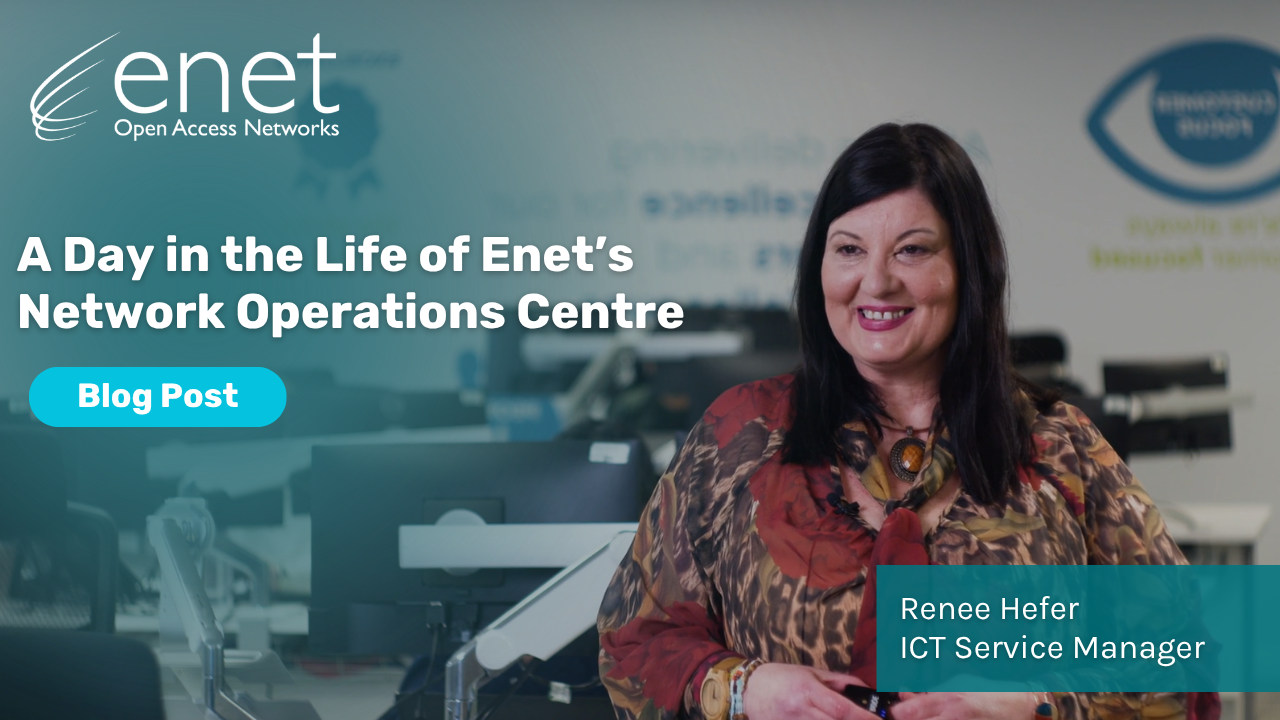
By Renee Hefer, ICT Service Manager at Enet
Start of the shift – the network never stands still
No two days are the same at Enet’s Network Operations Centre – otherwise known as the NOC – because the network never stands still. Operating 24/7, 365 days a year, the NOC is the operational heartbeat of Enet, where nationwide telecommunications and network systems are monitored and managed in real time to ensure continuous connectivity, reliability, and consistent network performance across critical national infrastructure.
Whether it’s early morning, the middle of the night, or a busy weekend, the NOC manages approximately 10,000km of fibre infrastructure, including the Irish State’s Metropolitan Area Networks (MANs), proprietary metro networks, dark fibre backhaul infrastructure, and one of the largest licensed wireless networks in the country.
Operating one of the largest wholesale telecom networks in Ireland, Enet enables Internet Service Providers ISPs to deliver services without the need to build their own infrastructure. This supports greater scalability and flexibility across the market.
Early in the shift – real-time visibility
From the moment a shift begins, the focus is on visibility. The Enet NOC is responsible for maintaining the stability, security, and performance of the entire network by monitoring it in real time, detecting any issues that arise and resolving them immediately before they impact customers.
Using advanced tools and platforms, the team continually tracks performance and scans for any irregularities. Even the smallest anomaly can signal a potential issue, so attention to detail is critical. This constant monitoring acts as the first line of defence against disruptions, performance degradation, and service outages.
If an issue does occur, the team respond immediately to minimise any potential disruption. They quickly assess the situation, identify the cause and take action to resolve it, working closely with field engineers, contractors and the internal technical teams. In many cases, issues are addressed before customers ever notice an impact.
Behind the scenes – supported by technology
Behind the scenes, automation and AI tools support the team by identifying patterns and improving response times. However, while technology enhances operations, it’s the experience and judgement of the people in the room that drive efficient operations. The team bring deep technical expertise, real-world experience and strong decision-making under pressure.
Their expertise means they can anticipate potential issues, respond with real precision and maintain high standards of performance and reliability.
While technology enables visibility and speed, it is humans who are used to managing complex network infrastructures that ensure quality outcomes.
Understandably, as networks continue to grow in complexity, the role of the NOC becomes even more critical in maintaining reliable service. Clear escalation paths and structured processes help keep everything moving, even under pressure. This ensures efficient incident management and seamless escalation when required.
Structured communication processes are key
One of the things people don’t always see is how the NOC is structured behind the scenes. We work across different support tiers, which helps make sure every issue is picked up by the right team as quickly as possible. Tier 1 is typically the first point of response. This is where alarms are actively monitored, alerts are assessed, customer queries and calls are managed, and the initial troubleshooting begins. A lot of incidents can be resolved at this stage through quick diagnostics and immediate action. If something needs deeper investigation, it moves to Tier 2. This is where more advanced fault finding takes place, whether that’s tracing the issue through the network, identifying the root cause, or working with field teams and other departments to restore service. For the more complex or critical issues, these are escalated to Tier 3. This is our specialist engineering level, where senior technical expertise comes in to deal with major incidents, recurring faults, or long-term fixes. It’s a really important structure because it means issues are escalated efficiently, and customers benefit from having the right expertise involved at the right time.
During major outages or planned works, the Service Desk Engineers are often the frontline for customer communication, triaging incidents, coordinating updates and ensuring customers receive timely and accurate information throughout the process. They also play an important role in managing access to Enet’s colocation sites and overseeing secure access points across the wider network infrastructure.
What sets the Enet NOC apart is our people, our culture, and our scale. We have a very strong people first culture, creating a sense of community that strengthens teamwork and performance. This close-knit environment is built on communication, trust, collaboration, and mutual support.
We do the same for our customers. We focus on consistent communication with them, clear updates and full transparency on all activity. The NOC team build strong relationships with customers over time and understand the importance of responsive, personal communication when issues arise.
End of shift – always on
Our mix of experience, teamwork, culture, technology and scale allows us to ensure the network remains resilient, reliable, and always operational. Ultimately, it is this commitment to excellence that keeps Ireland connected – no matter what time of the day it is.